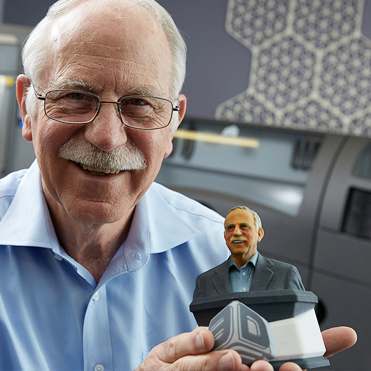
Chuck Hall (pictured below) was the first person to invent a 3D printer back in 1983. In the past 35 years, there has been many improvements in 3D printing. People were and still are fascinated by it. Now, a 3D printer can print with multiple different materials which has allowed it to be used in so many different ways. Also, small 3D printers have become affordable and now an average person can purchase his/her/their own and start creating personal designs. 3D printing is evolving and within the last 5 or so years Skylar Tibbits has started the movement of 4D printing.

Tibbits (pictured below) is the director of a self-assembly lab at MIT and gave a Ted Talk about what he has been working on in that lab. There, they are working on ways to make 4D printing a reality. It incorporates the normal 3 dimensions (length, width, and height) with the fourth dimension of time. This basically means that the object that is printed is able to transform itself into something else without using any outside mechanics or robotics. The only substance added to the object is some form of energy or stimulus that initiates the change. Which is pretty much basic physics, since energy cannot be created out of thin air, for the object to use energy to move, the energy must be added in. This energy normally comes from water, electricity, heat, wind, etc. The beakers pictured below is showing that when the beaker is shaken hard enough the object breaks apart, but when the beaker is shaken lightly, random energy is allowing it to piece itself back together in a repeatable fashion. It is done using geometry and understanding how these pieces will attract one another.


Posted by: Lisa Christen
Tibbits (pictured below) is the director of a self-assembly lab at MIT and gave a Ted Talk about what he has been working on in that lab. There, they are working on ways to make 4D printing a reality. It incorporates the normal 3 dimensions (length, width, and height) with the fourth dimension of time. This basically means that the object that is printed is able to transform itself into something else without using any outside mechanics or robotics. The only substance added to the object is some form of energy or stimulus that initiates the change. Which is pretty much basic physics, since energy cannot be created out of thin air, for the object to use energy to move, the energy must be added in. This energy normally comes from water, electricity, heat, wind, etc. The beakers pictured below is showing that when the beaker is shaken hard enough the object breaks apart, but when the beaker is shaken lightly, random energy is allowing it to piece itself back together in a repeatable fashion. It is done using geometry and understanding how these pieces will attract one another.


Tibbits took inspiration from nature. Mostly I read about inspiration coming from plants. As you can see in the image below, it looks like a flower blossoming. They studied how plants use energy to transform and tried to replicate that in the lab on different materials. With this technology items can go from a flat 2D object to a 3D object and vise versa on its own. Think about how much that would help on storage and moving! Nicholas Gerbis pointed out in his article How 4D Printing Works that this would also make disaster relief items easier to send. The eventual goal of this is to have shoes and clothes that transform based on the environment, self-transforming prosthetics and other medical implants, piping that can adjust to the environment, etc. The possibilities are endless. Tibbits and the people working with him in his lab have their work cut out for them, but if they can make their promises a reality, I think they will shock the world.
References:
http://www.evolo.us/biomolecular-self-assembly-skylar-tibbits-arthur-olson/ Posted by: Lisa Christen
Comments
Post a Comment